Posts

Showing posts with the label Off-the-Bench

Musical Christmas Card Activity

Image
In the final week of lessons for the year, after our big Christmas Festival concert is wrapped up, I like to unwind from the intensity of the last few weeks of concert prep and change up our usual lesson plan.  During this final week of lessons for the calendar year, we usually play through our holiday playlists (using Wendy Stevens' Seasonal Songs to Share resource ), maybe take a video of a favorites to share via the studio’s social media pages, and make a music centered holiday craft! This year for our craft I mocked up a quick Christmas Card, and I’m sharing a free template below in case anyone else would like to use it! Students will be filling in the music notes for the melody of the opening phrase of ‘We Wish You a Merry Christmas’ and can decorate the card in any way they like beyond that. I picked up some festive colored envelopes, and just like that we’ve got a simple lesson activity that can be kept or gifted depending on each student’s preference!  If you’d like to...

Resources for Building Musicianship

Image
In the Spring of each year students in our studio have the opportunity to participate in KMTA's Music Progressions. This is a musicianship evaluation that has 10 progressive levels, I won't get too far into the particulars because you can find  more information here.  But a big part of that musicianship is demonstrating an understanding of Music Theory both on paper and by analyzing what we are hearing. This blog post is a resource round-up of some leveled exercises that can help build these Theory & Listening skills.  All these exercises have been created on MusicTheory.net , which is an excellent free resource for teachers and students alike. These are designed to be a quick review or check-in on a concept, so each exercise is only 10 questions. And they don't even require you being near a piano. If your piano kid tries some, and would like to email me the codes with their scores, please do! I'll enjoy seeing their progress. Level 1 - Note names on keyboard and s...

History of Keyboard Instruments

Image
Next Monday we'll be having our first piano party of the school year, and it's the one where we learn all about the piano! So it seemed fitting for this week's blog post to finally finish up this one from my drafts encouraging us to think about the history of keyboard instruments.  The piano didn't just spring into being one day and then people started writing keyboard music, it evolved from a number of earlier keyboard instruments like the harpsichord and the clavichord . A lot of the early classical genre music that we now play on the piano was actually written on earlier keyboard instruments. Anything out of the Baroque Era (which includes everything JS Bach wrote) all pre-dates the piano as we know it, and a lot of early Classical period music as well. Understanding the differences in instrumentation at the time when certain pieces were actually written can really help us to interpret the music, and to understand how certain ornaments functioned to create more dyna...

Espressivo Piano Camp 2022

Image
Summer Day Camps are a major feature of summer for lots of children, and I am especially proud of our local Espressivo Piano Camp and what we are able to offer piano students for that first week of June each year. In this blog post, I wanted to share some highlights from this year's camp! One of my favorite sessions at piano camp for encouraging student curiosity and broadening musical experience and understanding, is our guest teacher session that happens in the middle of our week. This year we had pianist and organist Steve Gustafson come and give us an introduction to the organ. We learned a bit of the instrument's long history, and how it dates way back to before the Roman Era, and students got to pass around a few of the different types of pipes as we listened to the sounds they make and learned about the different stops and manuals on the organ.  Students even got the chance to volunteer to play the organ! Here are a couple Dawn's Piano students who gave it a try:  Ou...

Ear Training Resources for Piano Students

Image
Ear Training is an essential musicianship skill. It's what allows us to hear when a note is out of place in a piece of music, or to pick out a melody by ear. It's one half of audiating, the true musician superpower which combines both sight and ear training to be able to read and 'listen' to a piece of music in our heads.  Some of the beginning stages of ear training are to recognize things like directional movement (whether the notes are going up, down or staying the same), distance (if they're skipping, stepping or jumping over an interval), and quality (if we hear a major or minor chord or interval). This week's post is a round-up of some simple ways to practice Ear Training at home to help your piano kid develop and grow in this direction out of lessons.  Auralia While Auralia does offer a full curriculum for classroom & college teachers to assign to students ear training, in our studio we choose to isolate specific skills with the Auralia iOS apps . Wh...

Lord of the Chords - game review!

Image
Sometime last year our studio contributed to a kickstarter for a tabletop card came called ' Lord of the Chords' , and several months later received our physical copy of the game. Not too long after that I scheduled a game night with a couple local music teachers so we could get the hang of game play before implementing this game in our teaching. Today I'm writing up a short review of Lord of the Chords, and how I look forward to implementing it in lessons.  A short sum-up of game play: You try to build chords, and when you've built a chord in the chosen key signature, you get that key signature tile. Whoever gets 3 tiles first wins. It sounds fairly simple, but there's lots of fun strategy opportunities built in like 7th steals, and action cards that create all kinds of surprises as you go along. Also, when you first sit down to play, you look through the instrument cards and decide which one you'd like to be. Each instrument offers different advantages spe...

Book Review - Kid's Guide to Learning Ukulele

Image
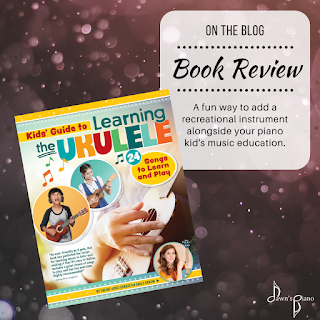
Today's blog post is a throwback to when I was a bookseller in the Children's Department at Vroman's Bookstore, and one of our regulars was a music educator, and singer/songwriter, named Emily Arrow. Emily frequently writes songs based on popular picture books ( here's her youtube channel ), and would often stop by to check out the new releases and visit about kid's books. And just last month, she released an instructional book on how to learn the ukulele that I'm very excited about.  Ukulele is one of those instruments that's pretty easy to pick up, especially for kids with some musical experience. A beginning instrument is not very expensive, and the neck & fretboard are the perfect size for little hands to get a start on a string instrument. With this book they'll learn about tuning, strumming, playing some beginning chords, learn up to 24 folk songs, and (my favorite) use the Song Recipe to write their own songs on the ukulele. The format ...

Staff Wars - Note Reading App Review

Image
Every so often, I like to share an music education app that will help with home practice, and today, I'm sharing one that is sure to be a hit called Staff Wars. This will be especially helpful for students who are preparing for the upcoming Progressions evaluations, and we will be using it in lessons for the next month or so to help build their confidence for the written portion of the exam. Staff Wars is a note reading app that can be played on an tablet or phone. It's set in outer space, and would be especially great for Star Wars fans, as the ship you are in looks remarkably like a public domain X-wing, and your objective is to shoot enemy notes out of the sky.  As you get notes correct you will level up, and the notes will start moving quicker to increase the challenge. After your three lives are used up, the game is over, and you can play again, trying to improve on your last score.  There are 2 ways to customize the notes you'll be trying to identify, especial...

Music at the Holiday Table

Image
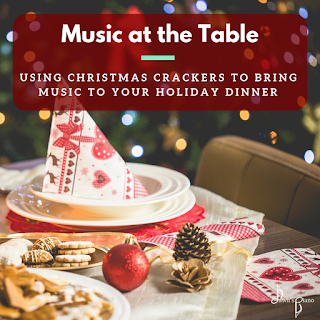
Today I'm sharing a fun idea, that is not by any means new, to bring some music to the holiday table at your upcoming celebrations and family dinners during the holiday season: Musical Crackers! Christmas Crackers are a holiday tradition in the UK that sort of resemble the celebratory poppers full of confetti that we sometimes use here in the states during the 4th of July or other celebrations. However instead of containing confetti, they usually contain a paper crown and a small gift, favor or joke. Christmas Crackers make appearances in Harry Potter and other iconic British shows and books that have scenes taking place around Christmastime, and are traditionally opened at the end of the holiday meal while still at the table. The sets that I am highlighting today are musical because each cracker contains the traditional paper crown and joke, as well as a small numbered instrument (chime, whistle or bell depending on the set you choose). They also come with some simple guides ...

"Here Come the High Notes" Book Review

Image
I've recently received our studio copy of a brand new picture book that puts teaching the treble clef notes into a story format, it's called Here Come the High Notes and is written by Marin Marka, illustrated by Alexandra Tatu.  I am looking forward to using this book in lessons, especially with my preschool and primer students, as a way to both introduce and familiarize the treble staff. Learning note reading takes time, and the directional reading and abstract thinking required for music notation can be difficult for younger learners. This is why I use so many resources that gamify this skill. And with the addition of this book to our studio library, we can start putting the treble notes into the context of a story as well! One thing that I enjoyed in this book is that each note is given a little bit of personality that comes into play as they choose their place on the staff. This helps differentiate them without weighing down the story with too much detail. The book d...

Open Piano Week

Image
During the first couple weeks of our Fall term, I had several students who were very interested in (and somewhat distracted by) the moving parts in the piano while they played their music. So I decided that during the final week of August, we'd have an "Open Piano Week" here in the studio. During lessons that week, the lid on the studio's baby grand was lifted and each lesson included in introduction to what goes on under the lid when we play music. Students had some great questions and observations, and were so engaged that I think for next school year, we will dedicate our first Piano Party to a detailed look at how the piano works!  So here's what we learned as we identified all the tiny moving parts that work together to make music when we strike the piano's keys: learning about dampers Strings - these are often the first things students noticed as we looked under the lid. We discussed how most of the notes on the piano have 3 strings that ring t...

Improvising at Home

Image
Earlier this month we had our first piano party of the new session where students learned about Improvisation. At our piano party, we discussed what it is, it's deep roots in classical, jazz and popular music and introduced some easy ways to get started, then we jammed with a Rock Your Way Back to School improv . Improvisation is a terrific rhythm and ear training tool, and the goal of this piano party was to help take some of the potential awkwardness or shyness out of this creative exercise. Today's blog post is looking at how you as a piano parent can support you piano kid improvising at home. What I'm going to share are some simple tips that even completely non-musical parents can use to create original improvisation with your piano kid. Some things to know about Improv:  Operates within a structure. Accomplished musicians rely on chord progressions, scales, knowledge of different genre styles, and tempo/rhythm structures to improvise. But total beginners can do...

Jump rope

Image
You've probably heard me talk about the Piano Parent Podcast before, and that's because it's a terrific resource for parents of piano students that covers a range of topics from getting creative with music and practice time, to common struggles, to some simple music theory lessons so parents know what's what in their students music.  Today, I'm sharing a recent discussion with piano teacher Vicki Conway that had some really insightful information about the importance of movement in brain development, and even gives some really simple activities we can do with kids to help them build some of those essential pathways in the brain to build skills in different kinds of reasoning and understanding.  I'm embedding both part 1 and part 2 of the conversation here so you can listen to them, and get the info straight from the source, and I'll also include some of my own thoughts below.  Developmental Fitness, Part 1   Developmental Fitness, Part 2 ...

Summer Reading List

Image
What better time than Summer to discover some great books?! Today's post is a book list that shares some titles that tell the stories of musical artists or composers, some that have fun with music, and some that explore having positive self-esteem (very important for artists who are in the habit of being vulnerable by putting themselves into performing situations). As a former children's bookseller, and an avid reader, connecting with people about books is one of my most favorite hobbies.  If you're looking for a way for your summer reading to get your piano kid out of the house, just head to your local library! Here in McPherson, the library's summer reading program gives kids a free book just for signing up, as well as entry into the drawing for the big prize. If they complete a reading log, they can earn more prizes AND more entries into the drawing. If you haven't checked that out already, you can learn all about the Summer Kid's Programming here, there ...