Posts

Showing posts with the label Healthy Home Practice Environment

Gardening & Piano Study
Image
One hobby that I've really grown to love in the past few years is gardening - especially now that we have a yard with space for me to grow things! And I've learned a lot from watching my flowers get established and eventually bloom. Some of these lessons can apply to piano lessons as well. And so in today's post, I'll be sharing 3 things I've learned from gardening that apply to learning piano.  1. It takes time. I got to celebrate my very first peony blooms this year. I planted them as root cuttings back in 2019. The first spring they came up small, second year I had a bit more foliage, and now in year three we finally got to enjoy some blooms.  There's a saying in the gardening world when establishing perennial plants, and perhaps you've heard it before: "First year they sleep, second year they creep, third year they leap." And this is because perennials are long-lived plants that will bloom year after year once established. But they do require t...
Studio Piano Maintenance

Image
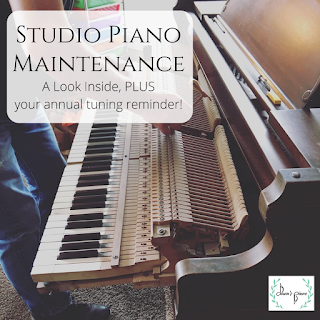
Piano Maintenance is a vitally important part of being able to practice, build healthy technique, and to play well. Our studio piano was due for a tuning this summer, and I also asked Chuck Vetter, our technician here in town, to see what he good do about the tone. Our studio piano is pretty old, and it sees a lot of regular use by lots of young, very eager pianists, so the action needed some TLC. I grabbed some photos while he was working because I thought students would enjoy seeing the inner workings of the piano, and here was the result:  Removing the Action from the piano to work on the voicing. We also took the opportunity to vacuum out the large dust bunnies that inevitably settle in over the years. The cabinet without the action. To improve the tone, Chuck worked on adjusting the felt on the hammers (on the left of this photo) so when they hit the strings they will create a warmer tone instead of a harsher sound. This process is called Voicing the piano. ...

Metronomes - which type is best?

Image
We're talking about metronomes today! This is one of those tools that depending on what kind you have and how you implement it, your piano kid will either learn to use as an effective tool, or to dread it. I'm not here to tell you which kind you have to get, because I believe different students can have different experiences and responses. And the good news is that we really do have a lot of options! So I'm sharing some of my observations on several different types of metronomes and their usefulness that will hopefully help you find a good fit to try in your home practice space. Smart Speakers When I was travel teaching, I had several students with smart speakers in the same room as the piano, and I loved the convenience of saying "Ok google, set a metronome to 120 beats per minute" and bam!, it would. I also saw that when the piano kids got to tell Google or Alexa to turn on a metronome, and articulate how many beats per minute they needed, or the time signa...

Healthy Home Practice Environment Part 4: Encouragement

Image
Today is the last week of our series all about setting up a Healthy Home Practice Environment, and I've saved a really important one. We're talking about encouragement. Piano kids work hard when they practice, and showing them that we recognize the work they are putting, and are proud of them for it, in is really important in inspiring them to keep it up.  One of the tricks about giving encouragement and feedback is to make sure that it is authentic. If your child played through a piece and it sounded like a train wreck, we don't want to say "that sounded really great!" because they have ears too and they know whether or not it did in fact sound great. If they get used to us using vague generalizations to protect their feelings, they won't be as ready to listen when we really have something valuable to say. At the same time, I know that non-musical parents may not always know exactly what to say to support their children during practice. So, today, I'm...

Healthy Home Practice Environment Part 3: Learning Tools

Image
Welcome back for part 3 of our series on setting up a Healthy Home Practice Environment! Last week we talked about some things to consider in making our home practice space more ergonomic for ease of use , and to support healthy technique. Today, I'm sharing some of my favorite home practice tools, or piano accessories if you will, that can help us achieve that. Here are my 5 favorite tools to enrich your piano practice space: 1. If your piano space could use some more light, try a piano lamp .  2. If your piano kid likes mechanical things, how about a metronome ? You can always download an app to a smart device, but having the real thing can be more fun and eliminate the distraction of a screen during practice time. 3. A footstool & something on the seat to boost their height (a folded blanket is my favorite quick fix) is good to have available for all practices.  If you have a little who is using the pedals and want to invest in something a bit more pi...

Healthy Home Practice Environment Part 2: Ergonomics

Image
Welcome Back for part two of our Healthy Home Practice Environment Series, and if you missed the first post about choosing where to put the piano you can read it here . I've titled this second part 'Ergonomics' for lack of a better term, because today we'll be talking about ways to make the space as functional, and as supportive for good technic and ease of movement, as possible.  I've talked on the blog before about how important technique is to keeping your piano kids hands, wrists and even shoulders healthy as they (hopefully!) spend more and more time at the instrument. And there are some simple things to do in your home set up that can encourage this.  Here are 4 quick things to take into account to support healthy technique.  Leave plenty of space behind the piano bench. One of the biggest factors in poor technique are when students are sitting too close to the piano. If you have another piece of furniture (like a table etc) right behind the piano b...

Healthy Home Practice Environment Part 1: Location

Image
Happy New Year everyone! We're jumping into the new year with a blog series about helping set up a Healthy Home Practice Environment that will encourage piano students to visit the piano often during the coming year.  Today our discussion is all about location. Where your instrument is located in the house can actually have a huge effect on your student's consistency in practicing. In creating a pleasant space to practice, you will show your child your family values music, and that can only help in instilling a sense of musicianship within themselves. Here are 5 key things to think about when choosing where to put the piano: 1. For those with digital pianos, your piano should have a permanent location.  An instrument that has to be stowed away under a bed or leaned against a wall between practice sessions is simply not going to get practiced enough. Show your child that music is worth investing in by creating a permanent space for them to build their musicianship ski...